Introduction
The monsoon season brings welcome relief from Kolkata’s summer heat. It also brings new challenges for every car owner. Wet roads, heavy traffic, potholes, and waterlogging can affect your car’s performance in many ways. One of the biggest safety concerns is weak braking.
Have you ever pressed the brake pedal during rain and felt that your car took longer to stop? If yes, you are not alone. Many drivers in Behala, Parnasree, and Sarsuna experience this problem every monsoon. Sometimes it is normal for brakes to feel slightly different after passing through water. In many cases, however, it can also indicate that your braking system needs attention.
Understanding the warning signs early can prevent accidents and expensive repairs. This guide explains why brakes feel weak during the rainy season, how you can identify potential problems, and when to seek professional Car Brake Repair in Behala.
At MI MOTORS, we help drivers keep their vehicles safe throughout the year with professional car inspections, honest advice, and quality repairs. Whether you drive daily to work or use your car mainly on weekends, maintaining your brakes should always be a priority.
Why Brakes Are Your Car’s Most Important Safety Feature
Your engine helps your car move.
Your brakes help your car stop safely.
Every journey depends on a reliable braking system. Even if your engine performs perfectly, worn or damaged brakes can put you and your family at risk.
A healthy braking system allows you to:
- Stop quickly during emergencies.
- Maintain better control on wet roads.
- Drive confidently in traffic.
- Reduce the risk of collisions.
- Protect tyres and suspension components.
Ignoring brake maintenance can increase stopping distance and reduce your ability to react during unexpected situations.
That is why regular brake inspections should always be included in your periodic Car Service in Behala.
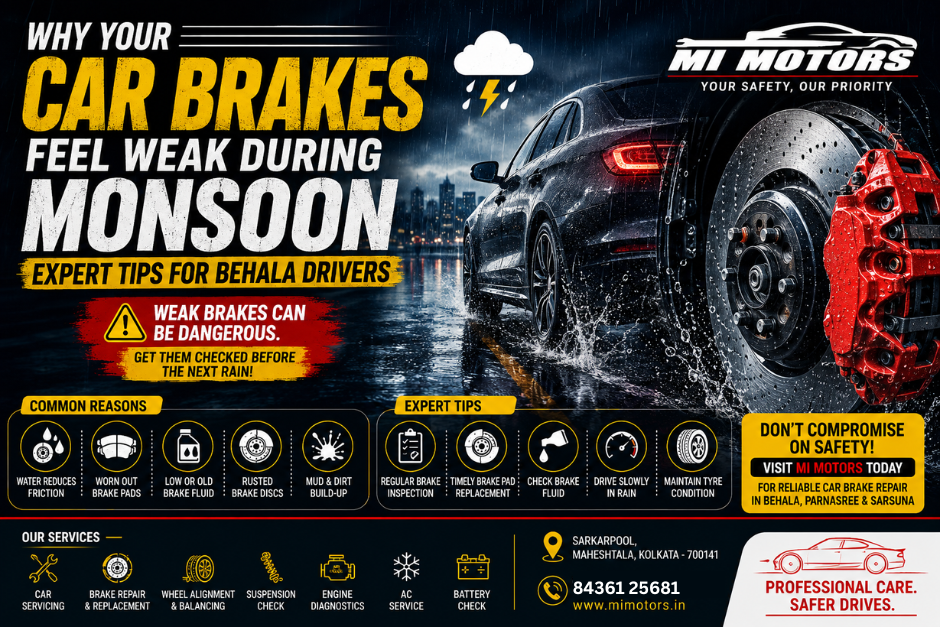
Why Do Brakes Feel Weak During Monsoon?
Many drivers believe rain itself damages brakes. That is not entirely true.
Rainwater affects the way braking components work, especially if they are already worn or poorly maintained.
Let’s understand the most common reasons.
1. Water Reduces Friction
Your brake pads create friction against the brake discs or drums to slow the vehicle.
When water enters this area, a thin layer forms between the surfaces.
This temporarily reduces friction.
As a result:
- Braking feels less effective.
- Stopping distance increases.
- The brake pedal may feel different.
In most cases, the brakes return to normal after a few gentle applications.
If the problem continues, you should get your vehicle inspected by a trusted Car Workshop in Behala.
2. Worn Brake Pads Become Less Effective
Brake pads naturally wear down over time.
During dry weather, slightly worn brake pads may still work reasonably well.
During monsoon, their performance drops much faster.
Common signs include:
- Longer stopping distance.
- Squealing sound.
- Grinding noise.
- Poor response.
- Vibrations while braking.
Replacing worn brake pads at the right time improves both safety and driving comfort.
3. Contaminated Brake Fluid
Brake fluid transfers pressure from the brake pedal to the wheels.
It plays a vital role in the braking system.
Brake fluid absorbs moisture over time.
During the rainy season, higher humidity accelerates this process.
Moisture-contaminated brake fluid can cause:
- Soft brake pedal.
- Reduced braking power.
- Brake fade.
- Corrosion inside brake components.
Routine brake fluid inspection is one of the most important services offered during Car Service in Parnasree and Behala.
4. Brake Disc Rust
Rainwater and humidity encourage rust formation.
A light layer of surface rust usually disappears after a few brake applications.
However, excessive rust can create problems.
It may cause:
- Pulsating brake pedal.
- Uneven braking.
- Brake noise.
- Reduced braking efficiency.
Professional inspection helps determine whether the discs need cleaning, resurfacing, or replacement.
5. Mud and Dirt Build-Up
Kolkata roads often collect mud, sand, and debris during heavy rain.
These particles may enter the braking system.
Over time, dirt increases wear on:
- Brake pads
- Brake discs
- Calipers
Regular cleaning during monsoon helps extend the life of your braking components.
Warning Signs You Should Never Ignore
Your car often gives early warnings before a brake failure.
Learning these signs can save you from expensive repairs and dangerous situations.
Brake Warning Light
Modern cars are equipped with dashboard warning lights.
If the brake warning light comes on, do not ignore it.
Possible reasons include:
- Low brake fluid.
- Worn brake pads.
- ABS malfunction.
- Brake system fault.
Visit a reliable Car Garage in Behala for a proper diagnosis.
Squealing or Screeching Noise
High-pitched noises are one of the earliest signs of brake pad wear.
Many brake pads include wear indicators that produce this sound intentionally.
The noise is a reminder that replacement is due.
Ignoring it may damage the brake discs, leading to higher repair costs.
Grinding Sound
Grinding usually means the brake pads are completely worn out.
Metal components begin rubbing against each other.
This can seriously damage the brake discs and increase repair costs.
If you hear grinding, stop driving as soon as it is safe and have the car inspected immediately.
Car Pulling to One Side
Does your vehicle move left or right while braking?
Possible causes include:
- Uneven brake pad wear.
- Sticking brake caliper.
- Brake fluid issues.
- Suspension problems.
This problem affects vehicle control, especially on slippery roads.
Brake Pedal Feels Soft
A soft or spongy brake pedal often indicates air or moisture in the brake lines.
This should never be ignored.
Professional brake bleeding and fluid replacement may be required.
Why Monsoon Driving in Behala Needs Extra Attention
Drivers in Behala, Parnasree, and Sarsuna often face unique road conditions during the rainy season.
These include:
- Waterlogged streets.
- Heavy traffic.
- Hidden potholes.
- Frequent braking.
- Narrow roads.
- Sudden pedestrian crossings.
These conditions put extra stress on the braking system.
Even a small brake issue can become serious if not addressed promptly.
Regular maintenance is far less expensive than emergency repairs after a breakdown or accident.
How Often Should You Get Your Brakes Checked?
Many people wait until they notice a problem.
That is not the safest approach.
Experts recommend:
- Brake inspection during every scheduled service.
- Brake fluid inspection every two years or as recommended by the vehicle manufacturer.
- Brake pad inspection every 10,000–15,000 km, depending on driving habits.
- Immediate inspection if you notice unusual sounds, vibrations, or reduced braking performance.
If you frequently drive through waterlogged roads in Behala, Parnasree, or Sarsuna, more frequent inspections are a wise precaution.
Why Choose MI MOTORS for Car Brake Repair in Behala?
Your brakes deserve expert attention.
At MI MOTORS, we believe safety comes before everything else.
Our brake inspection includes:
- Complete brake pad inspection.
- Brake disc condition check.
- Brake fluid testing.
- ABS system inspection.
- Brake line inspection.
- Road test after repairs.
We use quality replacement parts and follow transparent repair practices, so you know exactly what work is being carried out on your vehicle.
Whether you need routine maintenance or urgent Car Brake Repair in Behala, our experienced technicians are ready to help.
Maintaining your braking system during the rainy season is not difficult. Most problems can be avoided with regular inspections and a few good driving habits. Whether you travel daily through Behala, Parnasree, Sarsuna, or nearby areas, these expert tips will help keep your car safe and reliable.
1. Never Ignore Brake Noises
Your car often warns you before a major problem develops.
If you hear:
- Squealing
- Grinding
- Clicking
- Scraping
- Metallic noises
do not wait for the sound to disappear.
Many drivers continue driving for weeks after hearing unusual brake noises. This small mistake often turns a simple brake pad replacement into an expensive brake disc repair.
Getting your car inspected early can save both money and time.
2. Replace Brake Pads Before They Wear Out Completely
Brake pads are consumable parts.
Like tyres, they wear down with regular use.
Driving with completely worn brake pads can damage:
- Brake discs
- Brake calipers
- Brake pistons
Replacing brake pads at the right time is much cheaper than replacing the entire braking system.
If your vehicle has covered more than 30,000 to 40,000 kilometres, ask your mechanic to inspect the brake pads during your next Car Service in Behala.
3. Check Brake Fluid Regularly
Many people change engine oil regularly but completely forget about brake fluid.
Brake fluid absorbs moisture over time.
During Kolkata’s humid monsoon season, this happens even faster.
Old brake fluid can lead to:
- Poor braking
- Brake fade
- Soft brake pedal
- Internal corrosion
Manufacturers generally recommend replacing brake fluid every two years, although the exact interval may vary by vehicle model.
4. Drive Slowly Through Waterlogged Roads
One of the biggest mistakes drivers make is speeding through flooded roads.
Fast-moving water can:
- Splash onto the brake discs
- Carry mud into brake components
- Damage suspension parts
- Affect electrical systems
Drive slowly whenever you encounter waterlogged streets in Behala, Parnasree, or Sarsuna.
Slow driving protects not only your brakes but your entire vehicle.
5. Dry Your Brakes After Passing Through Water
If you drive through a shallow waterlogged area, gently press the brake pedal several times while driving slowly in a safe place.
This helps:
- Remove water
- Restore friction
- Improve braking response
Never perform this on a busy road or at high speed.
6. Maintain Proper Tyre Condition
Your braking performance depends on your tyres.
Even perfect brakes cannot stop a car efficiently if the tyres have poor grip.
Inspect:
- Tread depth
- Air pressure
- Sidewall condition
Replacing worn tyres significantly improves braking on wet roads.
7. Don’t Ignore the ABS Warning Light
Modern vehicles are equipped with an Anti-lock Braking System (ABS).
ABS helps prevent wheel lock during emergency braking.
If the ABS warning light appears:
- Get the system scanned immediately.
- Avoid delaying repairs.
- Do not assume the light will disappear.
ABS is particularly useful during heavy rain when roads become slippery.
8. Wash Your Car Frequently During Monsoon
Many drivers avoid washing their cars during the rainy season.
This is actually a mistake.
Mud, dirty rainwater, and road grime stick to the underbody and braking components.
Regular washing helps remove:
- Mud
- Sand
- Salt
- Dirt
An underbody wash also reduces rust formation.
9. Schedule Preventive Maintenance
Preventive maintenance always costs less than emergency repairs.
During every routine service, ask your mechanic to inspect:
- Brake pads
- Brake discs
- Brake fluid
- Brake hoses
- Brake calipers
- ABS sensors
A professional inspection takes only a short time but can prevent major safety issues.
10. Choose an Experienced Workshop
Brakes are one of the most critical safety systems in any vehicle.
Never compromise on quality.
Choose a workshop that offers:
- Skilled technicians
- Quality spare parts
- Transparent pricing
- Proper diagnostics
- Warranty on repairs where applicable
At MI MOTORS, every brake inspection follows a systematic process to ensure your vehicle is safe before it leaves the workshop.
Common Brake Problems Seen at MI MOTORS During Monsoon
Every rainy season, our workshop receives several vehicles with similar complaints.
Some of the most common issues include:
Brake Pads Worn Beyond Safe Limits
Many customers continue driving until the brake pads are completely worn.
This often damages the brake discs, increasing repair costs.
Low Brake Fluid
Brake fluid naturally reduces over time.
Sometimes leakage is also responsible.
Ignoring low brake fluid affects braking efficiency.
Rusted Brake Discs
Vehicles parked outdoors for long periods often develop surface rust.
Although light rust usually disappears after driving, heavy corrosion requires professional attention.
Brake Caliper Seizure
Mud and moisture can cause brake calipers to stick.
Symptoms include:
- Vehicle pulling to one side
- Uneven brake pad wear
- Reduced braking efficiency
ABS Sensor Problems
Water and dirt sometimes affect wheel speed sensors.
This can trigger dashboard warning lights.
Professional diagnostics help identify the exact cause quickly.
ABS vs Non-ABS Braking During Rain
Many drivers are unsure how ABS works.
Let’s simplify it.
Cars Without ABS
During emergency braking:
- Wheels may lock.
- Steering control reduces.
- Skidding becomes more likely.
Cars With ABS
ABS rapidly applies and releases braking pressure.
Benefits include:
- Better steering control
- Reduced skidding
- Improved stability
- Safer emergency braking
If your car has ABS, you may feel slight pedal vibrations during hard braking.
This is completely normal.
Driving Tips for Better Braking in Rain
Changing your driving style can greatly improve safety.
Maintain a Safe Distance
Wet roads increase stopping distances.
Leave extra space between your car and the vehicle ahead.
Avoid Sudden Braking
Brake smoothly.
Sudden braking can reduce control, especially on slippery roads.
Reduce Speed Before Corners
Entering a turn too quickly reduces tyre grip.
Slow down before reaching the corner.
Avoid Tailgating
Following another vehicle too closely leaves little time to react.
Maintain a safe gap at all times.
Stay Alert for Pedestrians
Visibility reduces during heavy rain.
Pedestrians and cyclists may appear suddenly.
Drive cautiously in busy areas like Behala Market, Parnasree, and Sarsuna.
Why Regular Brake Maintenance Saves Money
Some people postpone brake repairs to save money.
Unfortunately, delayed maintenance usually becomes more expensive.
For example:
- Replacing brake pads is relatively inexpensive.
- Ignoring worn pads may damage the brake discs.
- Replacing both pads and discs costs much more.
The same principle applies to brake fluid, calipers, and ABS components.
Preventive maintenance helps avoid unexpected repair bills while keeping your family safe.
Areas Served by MI MOTORS
MI MOTORS proudly provides professional brake inspection and repair services for customers across:
- Behala
- Parnasree
- Sarsuna
- Taratala
- Brace Bridge
- Sakherbazar
- Maheshtala
- Hide Road
- Thakurpukur
- Joka
If you’re searching for reliable Car Brake Repair in Behala, our workshop is conveniently located to serve these nearby areas with quality workmanship and transparent pricing.
By now, you understand why your brakes may feel less effective during the rainy season and what you can do to keep them in excellent condition. In this final section, we’ll answer common questions, clear up popular myths, and explain why professional brake maintenance is one of the smartest investments you can make for your vehicle.
Frequently Asked Questions (FAQs)
1. Is it normal for brakes to feel weak immediately after driving through water?
Yes, it can be normal for a short time.
When water reaches the brake discs and pads, it creates a thin layer that temporarily reduces friction. This usually disappears after applying the brakes gently a few times.
However, if the problem continues for more than a few minutes, your vehicle should be inspected.
2. How often should I inspect my brakes during the monsoon?
If you drive regularly in Behala, Parnasree, or Sarsuna, especially on roads with frequent waterlogging, it’s a good idea to have your brakes inspected at least once during the monsoon in addition to your regular service schedule.
If you notice any unusual symptoms, don’t wait for your next scheduled service.
3. How long do brake pads last?
Brake pad life depends on several factors, including:
- Driving habits
- Traffic conditions
- Road quality
- Vehicle type
- Brake pad material
For many vehicles, brake pads last between 30,000 and 50,000 kilometres, but heavy city traffic can reduce their lifespan. Regular inspections are the best way to determine when replacement is needed.
4. Can rain damage brake discs?
Rain itself does not usually damage brake discs.
However, constant exposure to moisture can lead to rust formation, especially if the vehicle remains parked for long periods.
Light surface rust is common and usually clears after driving, while deeper corrosion may require professional attention.
5. Why does my steering wheel vibrate when I brake?
Steering wheel vibration during braking may indicate:
- Warped brake discs
- Uneven brake pad wear
- Suspension issues
- Wheel alignment problems
A professional inspection is recommended to identify the exact cause.
6. Is brake fluid replacement really necessary?
Yes.
Brake fluid absorbs moisture over time, reducing its effectiveness.
Replacing brake fluid at the recommended interval helps maintain proper braking performance and protects internal brake components.
7. Can I continue driving if the brake warning light comes on?
No.
The brake warning light indicates that your braking system requires immediate attention.
Continuing to drive without inspection may increase the risk of brake failure.
8. Does ABS reduce stopping distance?
ABS is designed primarily to help maintain steering control during emergency braking by preventing wheel lock-up. On many wet roads it also improves stability, though stopping distance can vary depending on the road surface and conditions.
Common Myths About Car Brakes
Many misconceptions lead drivers to delay maintenance. Let’s clear up a few of them.
Myth 1: Brakes Always Make Noise Before They Fail
Not always.
Some brake problems develop silently, making routine car inspections essential.
Myth 2: New Brake Pads Don’t Need Inspection
Even new brake pads should be checked during regular servicing.
Other brake components may still require attention.
Myth 3: Rainwater Cleans the Brakes
Rainwater actually introduces moisture and dirt.
Regular servicing and cleaning remain important.
Myth 4: Brake Fluid Never Needs Replacement
Brake fluid degrades over time by absorbing moisture.
Ignoring it can reduce braking performance and increase repair costs.
Myth 5: Only Old Cars Need Brake Inspection
Every vehicle needs brake maintenance, regardless of age.
Even newer vehicles experience brake wear, especially in heavy city traffic.
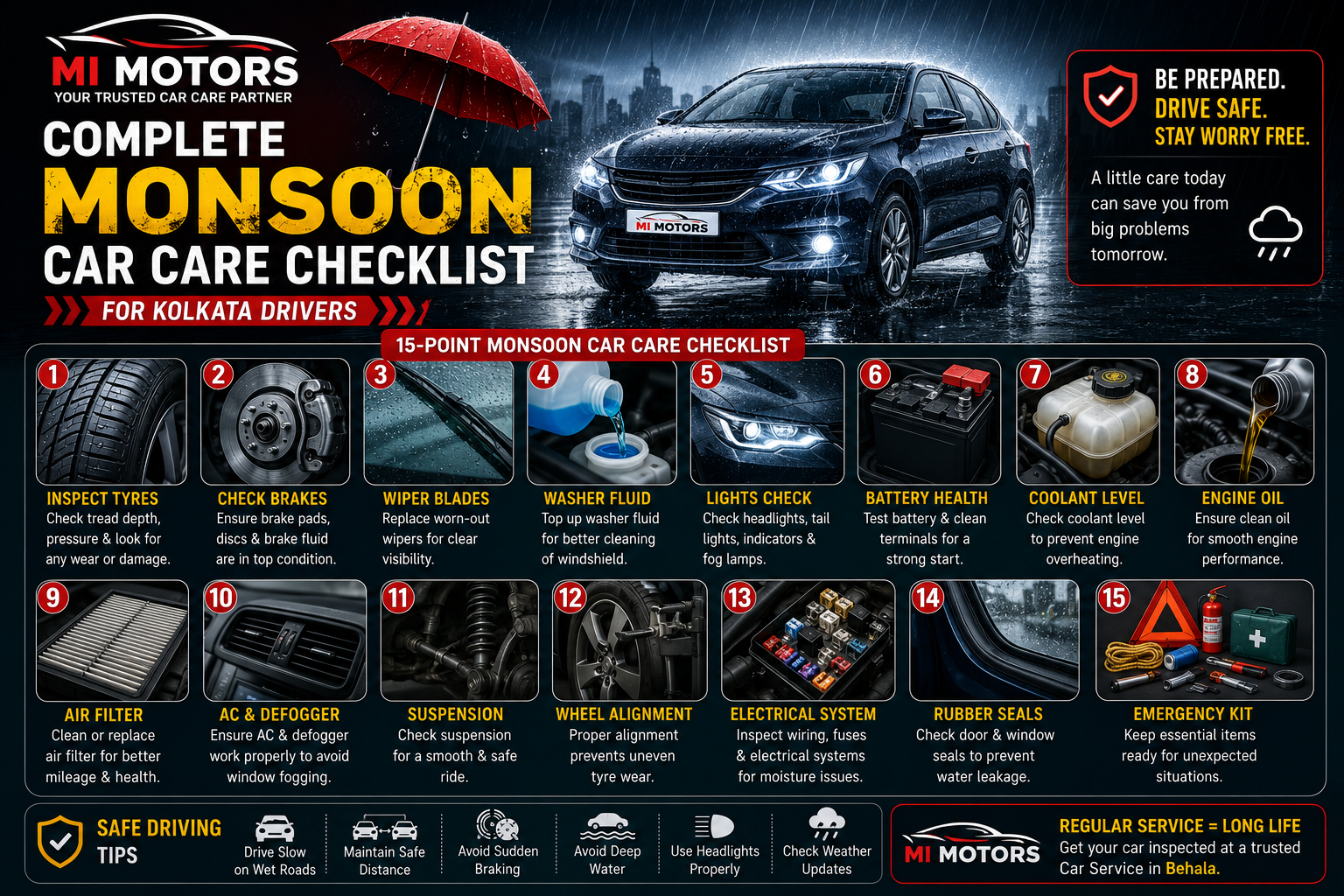
A Simple Monsoon Brake Maintenance Checklist
Use this checklist throughout the rainy season:
☑ Inspect brake pads regularly.
☑ Check brake fluid level and condition.
☑ Listen for unusual brake noises.
☑ Test brake response after driving through water.
☑ Inspect brake discs for excessive rust.
☑ Check tyre tread depth and tyre pressure.
☑ Wash the underbody to remove mud and dirt.
☑ Scan the ABS system if warning lights appear.
☑ Avoid aggressive braking on wet roads.
☑ Schedule a professional brake inspection before long trips.
Following these simple steps can significantly reduce the chances of unexpected brake problems.
Why Drivers in Behala, Parnasree and Sarsuna Trust MI MOTORS
At MI MOTORS, we understand that your family’s safety depends on the condition of your vehicle.
That’s why every brake inspection receives careful attention.
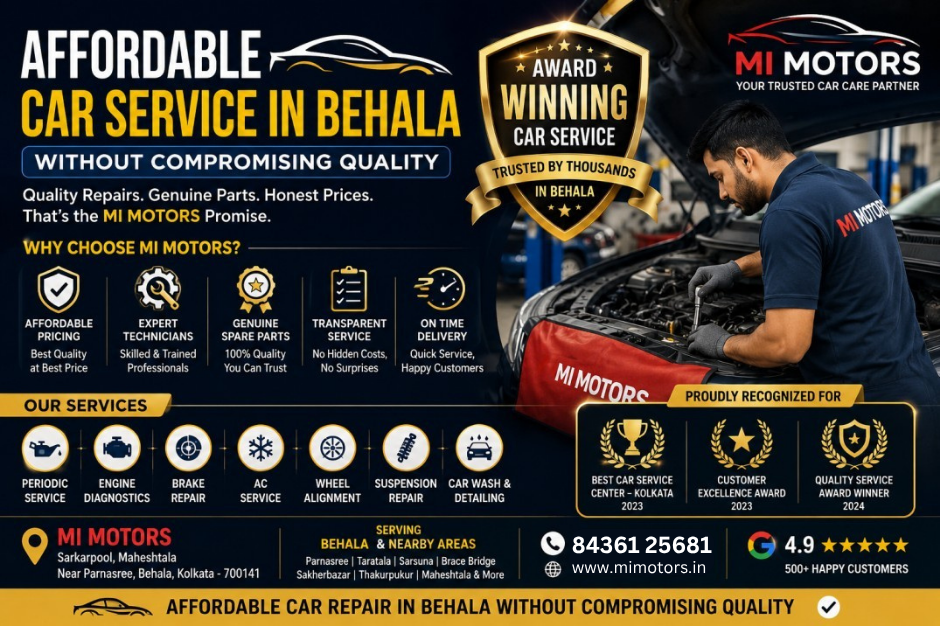
Our experienced technicians perform detailed checks using professional tools and follow a transparent repair process.
Our brake services include:
- Complete brake inspection
- Brake pad replacement
- Brake disc inspection and replacement
- Brake fluid replacement
- Brake caliper servicing
- ABS diagnostics
- Brake hose inspection
- Road testing after repairs
We explain every issue clearly before beginning any repair.
There are no hidden charges and no unnecessary replacements.
Our goal is simple—provide safe, reliable, and affordable vehicle care.
Conveniently Serving Nearby Areas
MI MOTORS proudly serves customers from:
- Behala
- Parnasree
- Sarsuna
- Taratala
- Brace Bridge
- Sakherbazar
- Maheshtala
- Hide Road
- Thakurpukur
- Joka
Whether you need routine maintenance or urgent Car Brake Repair in Behala, our workshop is easily accessible from these locations.
Why Preventive Brake Maintenance Is Always Worth It
Preventive maintenance offers several long-term benefits:
- Improved road safety
- Better braking performance
- Lower repair costs
- Longer life for brake components
- Better tyre life
- Increased driving confidence
- Improved resale value of your vehicle
Small investments today can prevent major expenses tomorrow.
More importantly, they help protect you, your passengers, and everyone else on the road.
Final Thoughts
Monsoon driving in Kolkata presents unique challenges. Wet roads, heavy traffic, and waterlogged streets demand a braking system that performs reliably every time you press the pedal.
If your brakes feel soft, make unusual noises, vibrate, or take longer to stop your vehicle, don’t ignore the warning signs. Early diagnosis is almost always less expensive than major repairs caused by delayed maintenance.
Regular inspections, timely replacement of worn components, and safe driving habits can help you enjoy worry-free journeys throughout the rainy season.
If you’re looking for trusted Car Brake Repair in Behala, MI MOTORS is committed to providing quality workmanship, honest advice, and dependable service for drivers across Behala, Parnasree, Sarsuna, and surrounding areas.
Book Your Brake Inspection Today
Don’t wait until a small brake issue becomes a serious safety risk.
Visit MI MOTORS for a comprehensive brake inspection and monsoon safety check.
Our Services Include:
- Brake Pad Replacement
- Brake Disc Inspection
- Brake Fluid Replacement
- ABS Diagnostics
- Complete Brake System Check
- Periodic Car Service
- Wheel Alignment & Balancing
- Suspension Inspection
- Car AC Service
- General Car Repair
MI MOTORS
📍 Sarkarpool, Maheshtala, West Bengal
Serving: Behala, Parnasree, Sarsuna, Taratala, Brace Bridge, Sakherbazar, Hide Road, Thakurpukur, Joka, and nearby areas.
Drive with confidence this monsoon. Let MI MOTORS keep your braking system ready for every journey.